
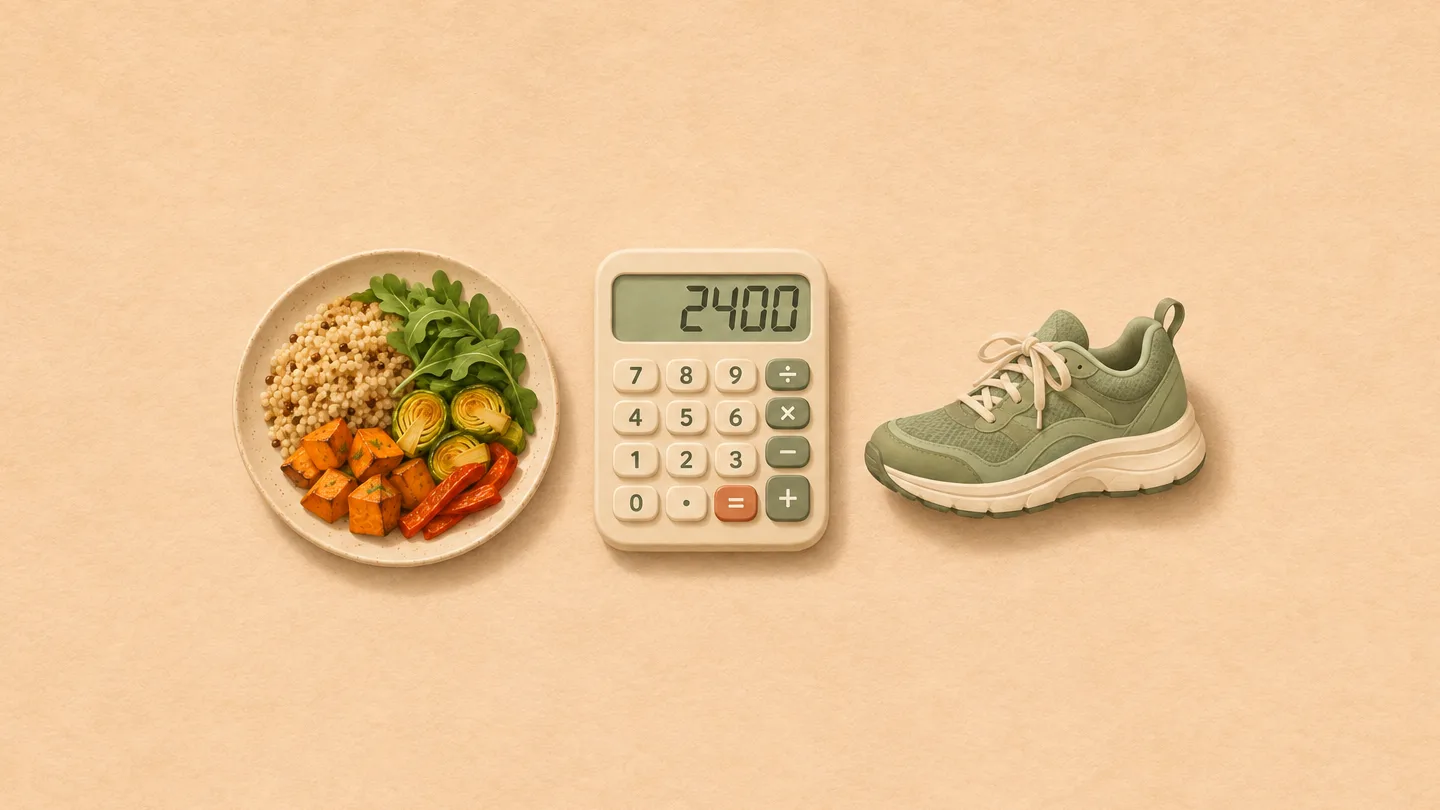
BMR (basal metabolic rate) is how fast your body burns calories at complete rest. Think of lying still in bed before breakfast while your body uses energy to breathe and keep your heart beating. TDEE (total daily energy expenditure) is the total you burn over a whole day. It includes your BMR plus the calories you burn digesting food, walking to the bathroom, brushing your teeth, and exercising.
Try the TDEE calculator
Enter your details to estimate your maintenance calories.
Say you work at a desk and run three times a week. Do you pick Light or Moderate? For the example in this calculator, that one choice changes the estimate by 310 calories a day.
The result is a starting estimate for how much you’d eat per day to keep your weight steady.
Which activity level fits your week?
Think about what you do between workouts, too. Three runs a week can look more like Light if you sit most of the day. Someone who runs just as often and spends their shifts walking or carrying things may choose a higher setting.
Change only the activity level for the default profile, a 32-year-old man who is 5 ft 10 in and weighs 174 lb. Here’s what the calculator shows:
| Activity setting | Multiplier | Estimated calories per day |
|---|---|---|
| Sedentary | 1.2 | 2,090 |
| Light | 1.375 | 2,400 |
| Moderate | 1.55 | 2,710 |
The difference comes from the activity multiplier. It reflects an assumption about the whole day, so you can’t use it to tell how many calories you burned on Tuesday’s run.
Should you add your workout calories?
If you picked Light because of those three runs, the 2,400-calorie estimate already makes room for them. You can still log a run for your records. If your tracker also increases that same budget when you log it, you’ll have counted the run twice.
Some trackers start with a baseline that leaves planned workouts out, then add them as you go. If you spend most of the day sitting, the calculator’s Sedentary setting shows what that kind of starting point can look like. Check how your tracker sets your budget before carrying over your TDEE.
Where does the number come from?
- Estimate what you burn at rest
The Mifflin–St Jeor equation starts with 10 × weight in kilograms + 6.25 × height in centimeters − 5 × age in years. The male equation adds 5 and the female equation subtracts 161. The calculator converts imperial units for you.
- Account for your activity
Multiply the resting estimate by your activity factor and round to the nearest 10 calories. For Light in the example above, that’s about 1,746 × 1.375, or 2,400 calories a day.
What if the estimate feels off?
Start by checking the activity setting. Your workday, walks, and workouts may add up differently from what the label suggests. If you’re aiming to maintain your weight and it keeps trending up or down over several weeks, revisit the estimate alongside what you typically eat.
Your energy needs can change along with your weight, so an estimate that fit before may need revisiting.
Sources
What makes up daily energy expenditure. National Academies, Dietary Reference Intakes for Energy (2023)
The original resting energy equation. Mifflin et al., American Journal of Clinical Nutrition (1990)
How energy needs change as body weight changes. Hall et al., The Lancet (2011)